JourneyMon Quick Start Guide
JourneyMon Devlog #6 - Building Mechanical Identities
JourneyMon launches on 28th October on
 Follow the campaign here!
2 weeks to go to the big day! Now’s a great time to follow the prelaunch page if you haven’t yet!
In today’s JourneyMon devlog I wanted to talk through my process for designing the powers for the nine Types used in the JourneyMon game. I felt it was important that each of the Types uniquely express their theme, generate diverse interactions during battles, and get players excited about exploring a new type when the Evolve or Recruit a monster.
The discussion here isn’t just about JourneyMon, though! This is a process that I think is useful for other games too, especially if they feature a game mechanic with multiple distinct themes. In traditional D&D-style fantasy that might correspond to different schools of magic. How is an illusion spell expressed in your mechanics differently to a transmutation spell, for example? In other games, it could be factions developing different styles of martial arts, or perhaps different organisations manufacturing signature weaponry.
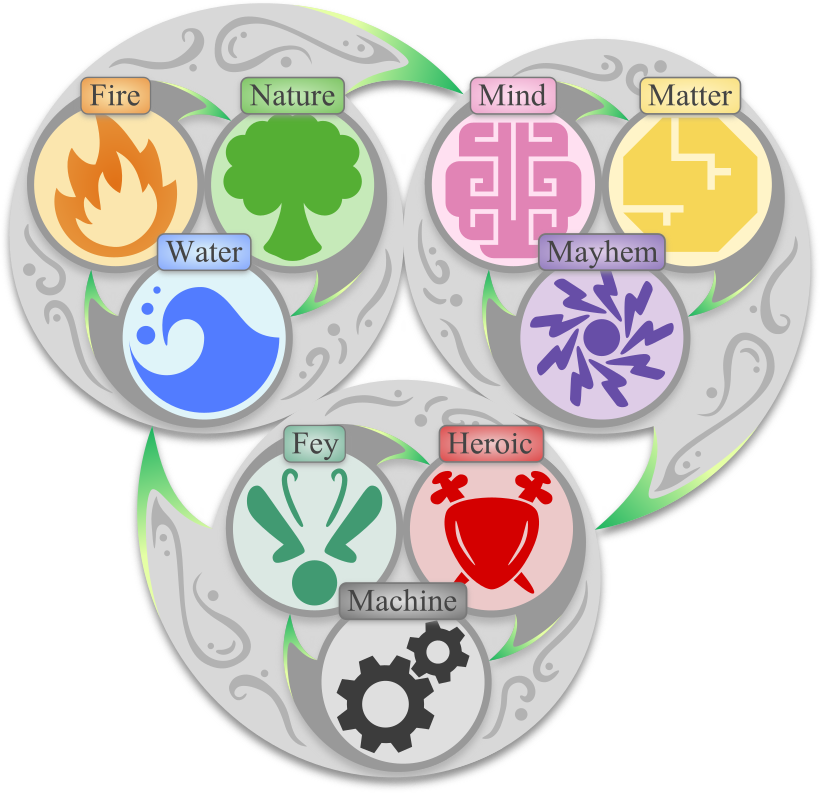
JourneyMon's nine type system is the subject of Devlog #2!
So let’s set out the design goals first:
- Each of the nine Types (Fire, Nature, Water, Mind, Matter, Mayhem, Fey, Heroic, Machine) should have its narrative theme expressed in its mechanics.
- Each of the nine Types should (ideally) interact with a different game mechanic.
- The purpose of the exercise is to develop guidelines, not hard and fast rules. Individual powers can deviate from what we decide if we wish.
Let’s get started!
Step 1: Verbs, Currencies, Dials
The first consideration is what does your system actually do? Broadly, I’m going to focus on three types of ways of interacting with a game, using terminology that’s probably familiar If you’ve delved into design before: verbs, dials and currencies.
Verbs are the ways in which a player directly interacts with the system. The usually represent active choices or triggered effects, especially in a context of controlling a character in a game. In a video game the verbs are usually quite clear. When you take control of Sonic in the original Sonic the Hedgehog, for example, you have a quite limited set of verbs: jump (on), run, roll. In a roleplaying game like JourneyMon, our verbs are:
- Make a Move (then Hit, Crit, or Miss)
- Roll dice
- Gain a Boon or Snag (i.e., roll extra dice)
- Change ownership of a Friendship token
- Spend a Friendship token
- Answer a prompt about the world/a character
- Use a Power in battle
- Move in battle
- Deal damage or take damage
- Suffer or end a condition
- … and more …
Currencies are (broadly speaking) how your system measures the state of play. Simple systems tend to have a few evocative currencies, and more expansive systems tend to have a complex web of interconnected currencies. You can also think of currencies as the answers to “what changes when my players use their verbs?” or "What does a verb cost?" JourneyMon’s currencies are:
- Friendship tokens
- Monster HP
- Rechargeable powers (i.e. Major and Apex powers)
- The number of conditions a player Trainer has (as gaining many can force you to leave or end a scene)
Dials usually opportunities to modify our verbs, making the more or less impactful. That sometimes includes increasing or decreasing the currencies that must be removed, gained or exchanged for any particular interaction. A simple dial in a game like D&D is to change critical threat range from 19-20 instead of only a natural 20. In JourneyMon, examples of dials are:
- The range on the dice that cause a move to Hit, Crit or Miss
- How much of a bonus a Friendship token conveys
- How much damage a Power deals
- How much damage conditions do
- How much of a penalty conditions convey
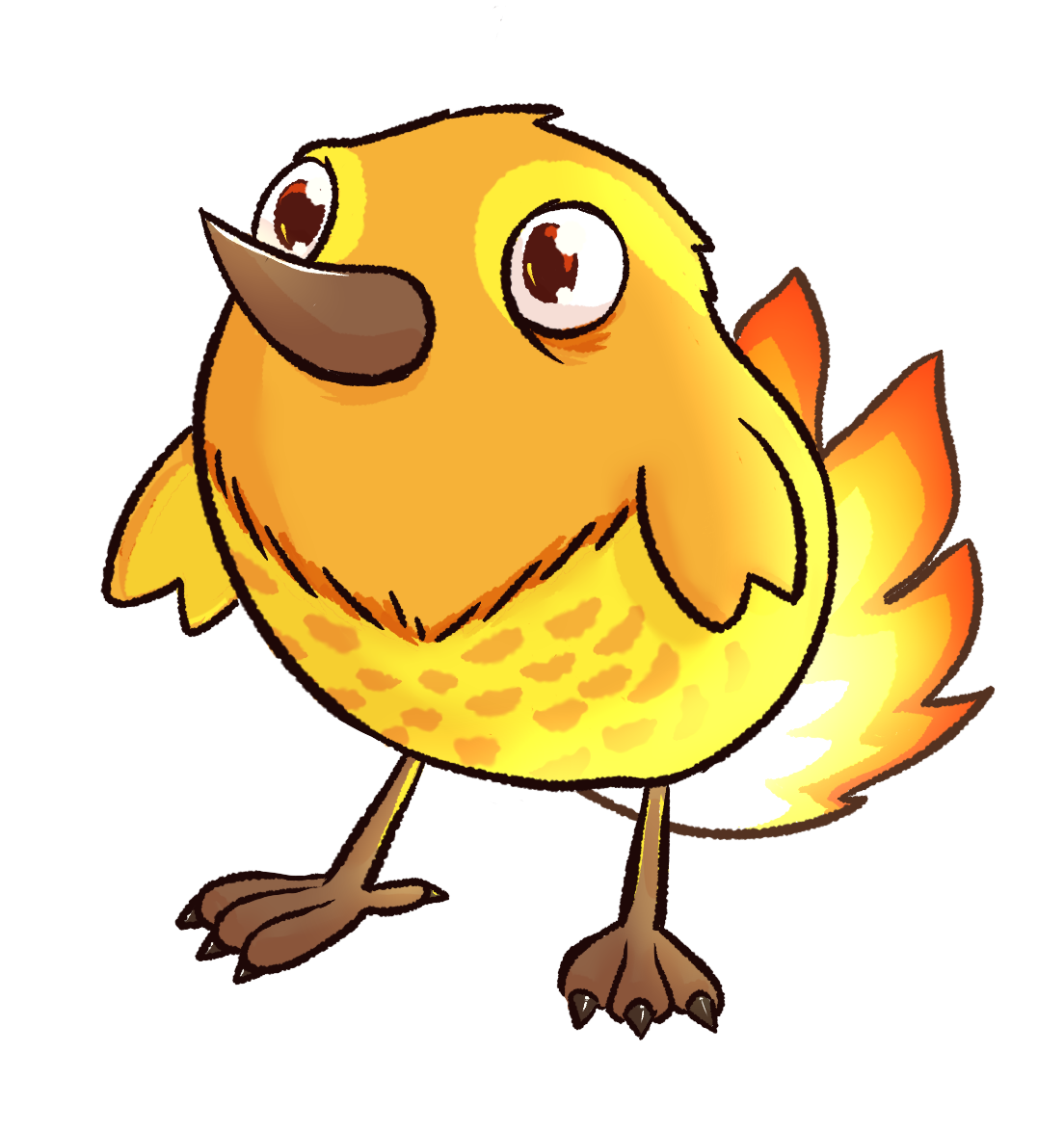
Quailblazer, a tiny Fire-type monster
Step 2: Match Themes to Mechanics
Now that we have our list of what our system can do, we need to try to match those verbs, currencies and dials to the themes we want our nine Types (or fighting styles, spell schools, factions, manufacturers etc.) to represent. We can look for variety here: some Types might modify verbs or add new ones. Others might move currencies around, or turn dials up or down. You could start from your verbs, dials and currencies and match each to a mechanic, or start with your mechanical types and figure out ways they might interact with your game system. Let's try the latter here:
- Fire:
- Burning - [Verb] cause ongoing damage
- Warmth - [Dial] reduce impact of conditions or [Verb] end conditions
- Nature:
- Healing - [Currency] restore HP or [Verb] end conditions
- Growth - [Dial] increase damage
- Poison - [Verb] cause ongoing damage
- Water:
- Flow/Fluidity - [Verb/Dial] grant extra movement
- Ice/Freezing - [Dial] restrict or reduce movement
- Mind:
- Influence - [Verb] cause conditions and Snags when you interact with the enemy
- Telekinesis - [Verb] change the environment
- Matter:
- Stability - [Dial] reduce damage, reduce conditions
- Earth - [Verb] affect areas
- Mayhem:
- Chaos - [Dial] interactions with Crits to keep the most extreme effects occuring
- Storms - [Verb] A trickier one... Perhaps we could representing sparks or flashes of lighting with exploding dice, or other methods of letting players keep rolling dice!
- Fey:
- Trickery - [Verb] cause conditions and Snags when enemies interact with you (notably reversing the Influence theme of the Mind type)
- Illusion - [Verb/Dial] change opponent’s actions
- Heroic:
- Protection - [Dial] reduce damage
- Self-sacrifice - [Currency] trade HP for damage
- Teamwork* - [Verb] take advantage of allies' positioning, or [Currency] move around Friendship tokens
- Machine:
- Momentum - [Verb/Dial] trigger effects on movement, or [Dial] increase or decrease the Intensity (itself a form of Dial on damage)
- Algorithm - [Verb] check for specific combinations of dice rolls
The mechanical element chosen as a type’s primary theme is shown in bold. These are generally the most evocative or mechanically interesting and have several powers designed around them. As JourneyMon develops more, you’re likely to see the secondary themes explores more too!
* - Interestingly, there are a few items on this list that don't really work. The best example here is the "teamwork" theme of the Heroic type. It seems quite obvious that a power set based on teamwork should take advantage of Friendship tokens in some way. However, Friendship tokens are an exclusively a tool of the player characters... NPCs never get them! In that case, building Friendship tokens too strongly into how the Heroic type works would vastly limit the options of villains and other NPCs that use Heroic type monsters. In the full JourneyMon game, you'll find that the use of Friendship tokens in Heroic powers is limited to the Apex Power (the strongest Heroic move in the game).
Step 3: Telegraph Your Mechanical Themes
The final piece of this game design puzzle is in how to communicate mechanical themes to the players. To take Magic the Gathering as a classic example, the mechanical themes of each "draft archetype" are communicated to players most explicity in it's two-colour uncommons. If the blue and green uncommon card does something with +1/+1 counters, it tells a draft player to look for synergies in other blue or green cards that involve +1/+1 counters, or triggers based on those counters. JourneyMon and many other TTRPGS are a lot lot less mechanically complex than Magic the Gathering, but a similar design principle can still apply.
The solution for JourneyMon is in it's Minor Powers, like Tackle:
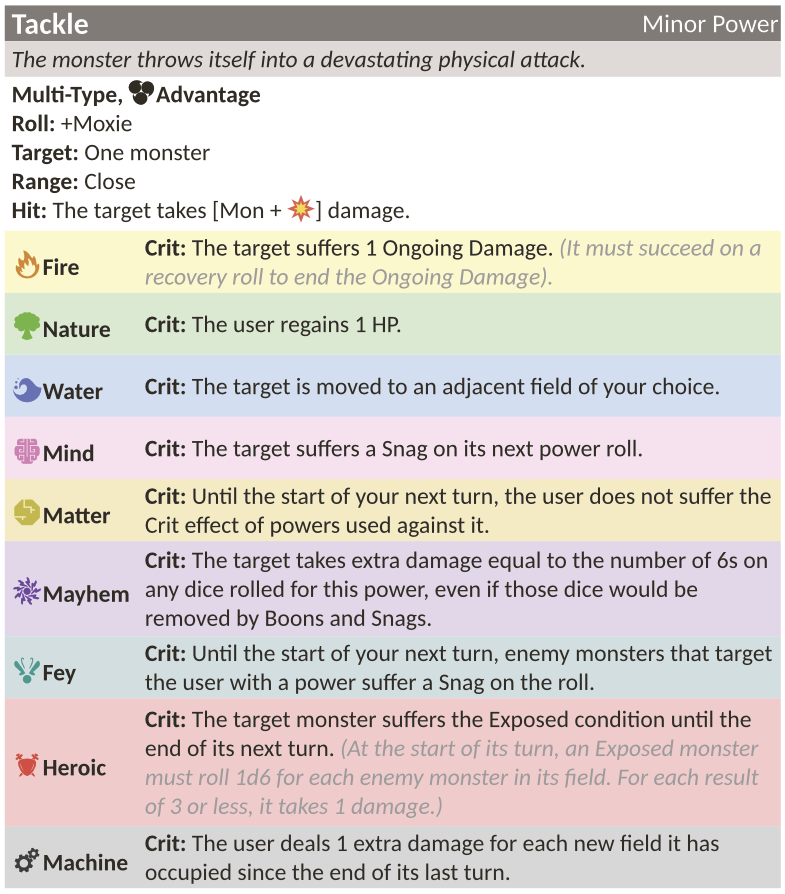
The four Minor Powers (Tackle, Blast, Boost, Protect) are probably the ones most commonly used during battles, and almost certainly the first powers that a player is going to use during the first battle of their Pilot Episode. The Minor Powers all have a variable Crit effects keyed to each of the nine Types, and each of those Crit effects telegraphs the broad theme for the players. The Nature version restores HP, the Mind version applies a debuff, and the Mayhem version encourages rolling as many dice as possible. Both Tackle and Blast have these same effects, whereas Protect and Boost have an alternative set of Crit effects that showcase a different set of mechanical themes.
Wrap Up
With that, you're ready to fill out your TTRPG with dozens of other powers! As a summary:
- Identify your system's moving parts, perhaps considering your Verbs, Currencies, and Dials.
- Map out the themes you want your "types" to represent, then match Verbs, Currencies and Dials to each of those themes.
- Decide which of those matches offer the most fruitful design space.
- Find a way to clearly communicate your mechanical identities to the players.
Have you gone through a similar design process to create mechanical identities for your own TTRPG? Have you played a TTRPGs of someone else's design with strong sets of mechanical identities? I'd love to hear about them in the Comments!
Otherwise, remember to follow the pre-launch page for the JourneyMon Kickstarter to be among the first to back the game!
Leave a comment
Log in with itch.io to leave a comment.